
Hancock County Court Records After Arrest
After a Hancock County jail arrest, two records tracks may exist at the same time. The jail profile is a custody record. It can show booking date, booking origin, charge descriptions, bond rows, court-date rows, and the housing facility. The court docket is the formal case record. It shows the complaint, information, indictment, amended charge, plea, disposition, sentence, warrant activity, and court orders when those items are filed or docketed.
The distinction matters because a booking charge is not always the charge that controls the case. A prosecutor may amend, reduce, dismiss, or replace a booking charge after review. For custody and booking details, use the Hancock County jail inmate records workflow. For booking photos, use the Hancock County jail mugshots page. For filed charges after an arrest, search the municipal or county court record.
In Hancock County, Ohio, the main court-record channels are Findlay Municipal Court for TR and CR municipal traffic or criminal cases, the Hancock County Clerk of Courts and eServices portal for common pleas records, and in-person clerk offices for older records not available online. The prosecutor's office is the charging authority for felony and common pleas criminal work, but public docket searches run through court and clerk systems.
Search Court Records After Arrest
The cleanest search starts with the jail profile. Copy the court name, docket number, court date, charge description, booking origin, and arresting agency from the Hancock County Inmate Inquiry profile. Then match those clues to the right court portal. Municipal case numbers often use formats such as TRD, TRC, or CRB. Felony and common pleas matters are more likely to route through the Hancock County Clerk of Courts and Common Pleas Court.
- Open the jail profile and copy the docket number, court name, charge text, and court date.
- Use the Findlay Municipal Court TR/CR case search for municipal traffic and criminal cases.
- Use the Hancock County Clerk of Courts and eServices portal for common pleas records.
- Compare the formal charge list to the booking charge on the jail profile.
- Check the charge status, bond order, next hearing, disposition, and sentence fields when available.
The Findlay Municipal Court portal warns that records are generated from computerized court records and may lag behind filed or docketed changes. Errors and omissions should be reported to the court at 419-424-7141, and older municipal records require an in-person visit.
Findlay Court Records After Arrest
The Findlay Municipal Court portal is the key online search for many local traffic and criminal cases after a Hancock County jail arrest. The municipal landing page directs users to the case search, daily docket, hearings, and active warrants. It also warns users to review the disclaimer because computerized court records may not reflect every change that has not yet been docketed or filed.
The direct Findlay TR/CR case search screenshot shows the searchable fields used for municipal court records after an arrest.
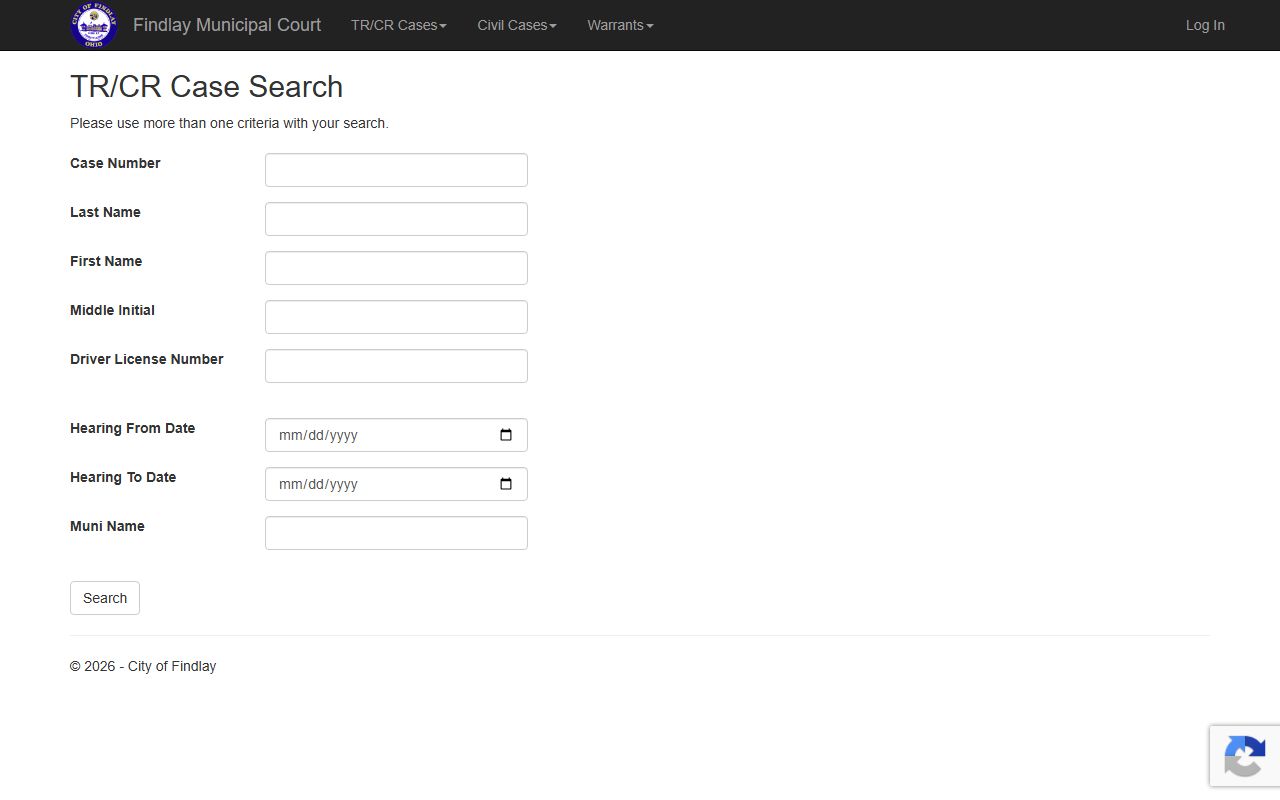
Use more than one search criterion when possible, especially if the defendant has a common name or the court case number is incomplete.
| Field Label | Type | Required | Notes |
|---|---|---|---|
| Case Number | Text | Optional | Examples from warrant data include TRD, TRC, and CRB formats. |
| Last Name | Text | Optional | Defendant last name. |
| First Name | Text | Optional | Defendant first name. |
| Middle Initial | Text | Optional | Single initial field. |
| Driver License Number | Text | Optional | Useful for traffic or traffic-criminal cases. |
| Hearing From Date | Date | Optional | Start of hearing date range. |
| Hearing To Date | Date | Optional | End of hearing date range. |
| Muni Name | Text or context field | Optional | Label exposed in the public form text. |
Hancock County Clerk Records
Common pleas criminal matters and other county court records route through the Hancock County Clerk of Courts. The official Clerk of Courts page names Clerk Cathy Prosser Wilcox and lists the legal department at 300 S Main Street, Findlay, OH 45840. The legal department phone is 419-424-7037, fax is 419-424-7801, and office hours are Monday-Friday, except legal holidays, 8:30 a.m.-4:30 p.m. The county's eServices link is the online search path when the record is available through the portal.
The Clerk page is also important for older records. The county portal says records before January 1985 require a visit to the Hancock County Clerk of Court's office at 300 South Main Street. Findlay Municipal Court has a different old-record rule: municipal records before January 1984 require visiting 318 Dorney Plaza, Room 206. Those cutoffs prevent a common mistake, which is assuming a missing online record means the case never existed.
The official Hancock County Clerk of Courts page is shown in the matching screenshot.
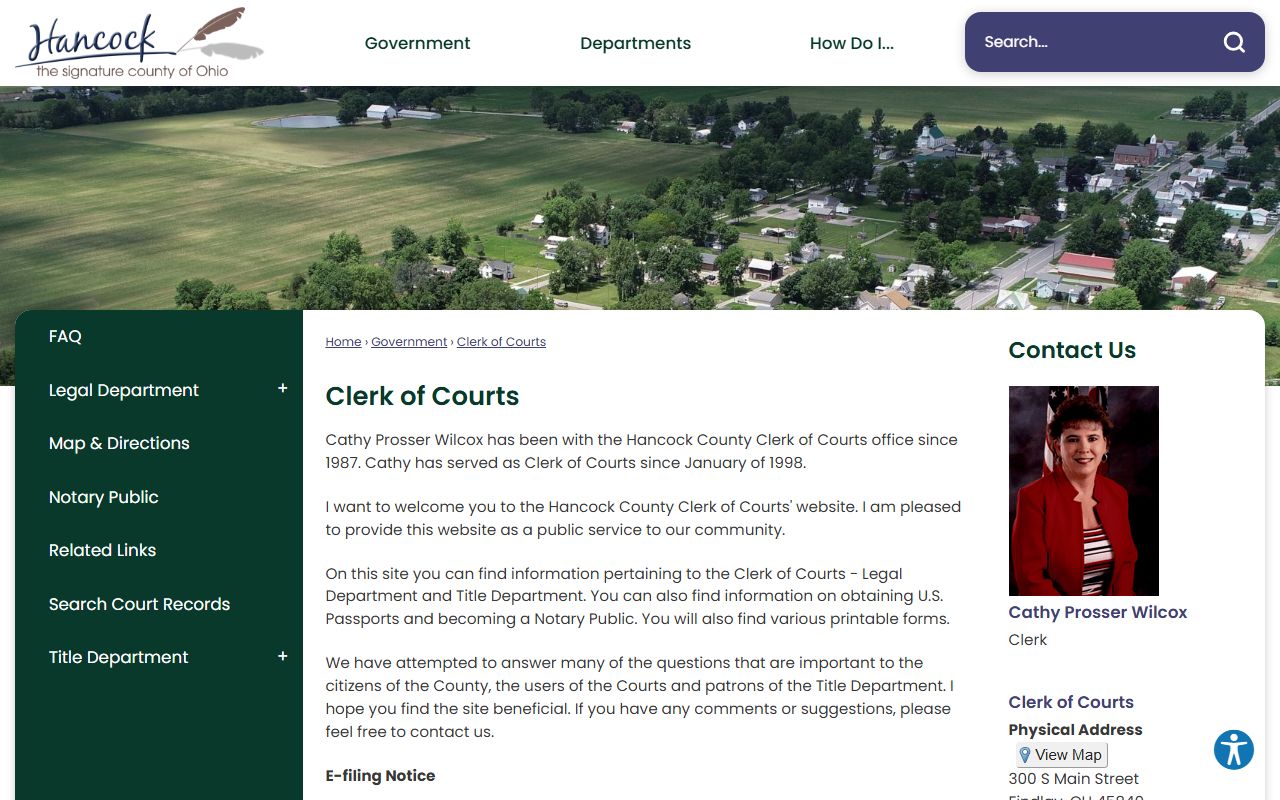
The Clerk's office is the better route for common pleas docket access, while Findlay Municipal Court remains the better route for municipal TR and CR cases.
Hancock County Charging Authority
Ohio uses county prosecutors, not district attorneys. The Hancock County Prosecutor is the local office tied to felony and common pleas charging decisions. The official county page names Sean M. Abbott as Prosecuting Attorney and lists divisions for Adult Diversion, Civil, Criminal, Juvenile Diversion, and Victims Assistant. The office is at 514 South Main Street, Suite B, Findlay, OH 45840. The public phone is 419-424-7089, and hours are Monday-Thursday 8:30 a.m.-4:30 p.m., Friday 8:30 a.m.-4:00 p.m., closed daily noon-1:00 p.m.
The prosecutor page says service for documents, motions, or appeals may be sent by fax to 419-424-7889 or by email to the prosecutor, with questions directed to the public phone. For records after a jail arrest, that does not mean the prosecutor is the case-search portal. It means the prosecutor's criminal division helps explain why a jail charge may later become a different formal charge in Common Pleas Court.
| Charging Document | What It Does | Common Hancock County Context |
|---|---|---|
| Complaint | Starts a case by alleging an offense. | Common in municipal criminal or traffic-criminal cases and initial felony proceedings. |
| Information | Prosecutor-filed charging document used when permitted. | May be used in some felony contexts. |
| Indictment | Grand jury charging document. | Common Pleas felony prosecution. |
Hancock County Charge Status
A court record after a jail arrest should be read as a timeline, not a single label. The first jail charge can be a starting point. Later docket entries may show a complaint filed, an amended charge, a reduced charge, a dismissal, a plea, or a sentence. The final outcome is the court disposition, not the first booking text.
| Status | Plain Meaning | Why It Matters |
|---|---|---|
| Pending | The case or charge is still open. | No conviction should be inferred from a pending accusation. |
| Amended | The charge text or legal level changed. | The final case may differ from the jail booking row. |
| Reduced | The charge was lowered to a lesser offense. | Bond, plea terms, and sentencing exposure may change. |
| Dismissed | The charge was dropped by court action. | The arrest or booking may still have existed as a record. |
| No Bill | A grand jury did not return an indictment. | Ohio sealing rules may become relevant after eligible outcomes. |
| Convicted | A plea or verdict resulted in guilt. | This is different from a mere charge or arrest. |
Important: A charge on a jail profile is an accusation or custody entry, not proof of conviction.
Warrants Bond and Arrest Records
Warrants often explain why a person was booked into the Hancock County Justice Center. The sheriff's Transport/Warrant unit receives, maintains, and executes warrants for Hancock County Common Pleas, Domestic Relations, Juvenile, Probate, Findlay Municipal Court, Fostoria Municipal Court, and other courts. The unit also transports offenders to and from jails and prisons within Hancock County court jurisdiction and to medical appointments.
Findlay Municipal Court publishes an active warrants list. On inspection, it listed 3,068 warrants, sorted by issue date, with pagination. Fields included defendant, case number, date of birth, issue date, agency, and warrant reason. Example reasons included failure to appear for hearings, non-compliance, ability-to-pay hearings, and fingerprinting-related non-compliance. Each warrant row linked to case details.
The active warrant screenshot from Findlay Municipal Court shows the data a warrant row can provide.
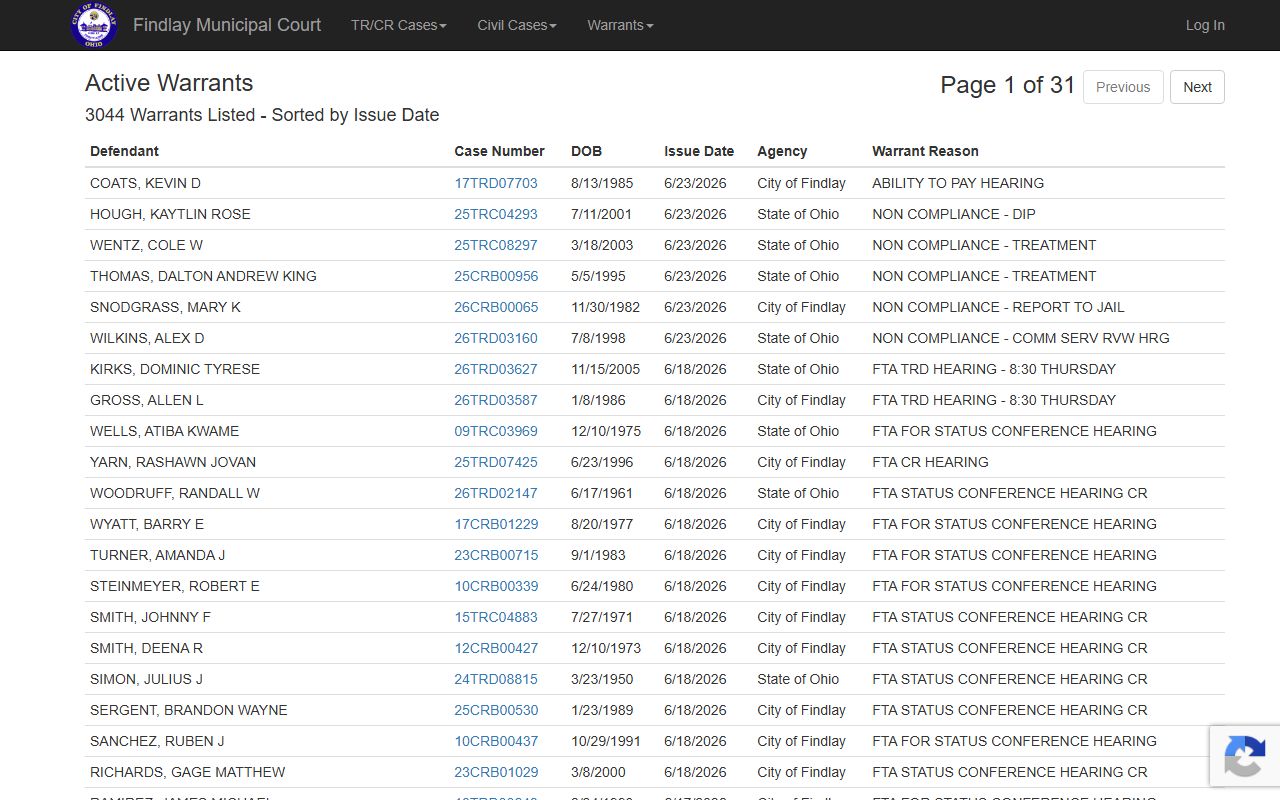
Use the issuing court for warrant instructions. Active warrants can lead to arrest and booking, and no page should advise a person to appear without first confirming court, counsel, and bond instructions.
| Bond Type | How It Works |
|---|---|
| Cash Bond | Money is paid directly in the court-set amount. |
| Surety Bond | An authorized surety or bail agent posts the bond. |
| Personal Recognizance | The court releases the person on promise and conditions rather than cash. |
| No-Bond Hold | Payment alone will not release the person because of a court order, sentence, detainer, or other hold. |
Charges Convictions and Court Records
The words charge and conviction are not interchangeable. A charge is an accusation filed or carried in a case. A conviction is the result of a guilty plea, no-contest plea with finding, or verdict. Hancock County court records after a jail arrest can show both, but the timing and wording must be read carefully.
| Point | Charge | Conviction |
|---|---|---|
| Stage | Filed accusation or pending count. | Final result after plea or verdict. |
| Proof Level | Based on probable cause or charging review. | Requires proof or plea sufficient for judgment. |
| Can Change | May be amended, reduced, or dismissed. | May be appealed, sealed, expunged, or otherwise modified only through legal process. |
| Use in Screening | Must not be treated as guilt. | Still subject to FCRA and Ohio record limits when used by regulated screeners. |
Sealed Expunged Arrest Records
Ohio law distinguishes public access from record relief. ORC 149.43 is the baseline public-records law for records kept by public offices, but exemptions can apply. Juvenile matters, sealed records, medical information, certain investigatory material, victim or witness protection issues, and other protected data may be withheld or limited. Court records after an arrest can remain public unless a statute or court order restricts them.
ORC 2953.32 governs sealing and expungement eligibility for certain convictions and postconviction records. ORC 2953.33 covers sealing of official records after not guilty findings, dismissals, grand jury no bills, and pardons. Eligibility and effect depend on the case result, offense type, prior record, timing, and court order.
| Point | Sealed | Expunged |
|---|---|---|
| Public visibility | Hidden from general public access. | Destroyed, deleted, or treated as not existing where the statute allows. |
| Official access | Some agencies may retain limited access by law. | Access is more restricted and depends on the order and statute. |
| Common trigger | Eligible conviction or eligible non-conviction record. | Eligible offense and statutory conditions. |
| Where to file | The court that handled the case. | The court that handled the case. |
Hancock County Record Limits
Public court and jail records can be incomplete, delayed, or split across systems. Findlay Municipal Court warned in 2026 that records had not updated since February 11, 2026, scanned images were not currently available for viewing, and a bug could redirect links to the City of Findlay homepage. The court advised users to copy or paste the direct hearings portal URL if that happened. That kind of notice is a reminder to verify important case facts with the court or clerk, not just a search result page.
The sheriff's records process is separate from court search. If the needed arrest report, warrant service record, booking record, or incident material is not in a public portal, use the sheriff's NextRequest portal or records contact channels. Sheriff records are generally available three to five business days after an event, and requests are handled during Monday-Friday business hours. The sheriff records page lists a $4.00 fee for accident reports, witness statements, and narratives, a $4.00 fee for photos on an HCSO disc, and no charge for photos on a requester's disc.
Important: Hancock County Inmate Population is not a consumer reporting agency, and records here may not be used for FCRA-covered decisions.